Field guide / 01 / Ecological time
Ancient forests: Time held in a living system
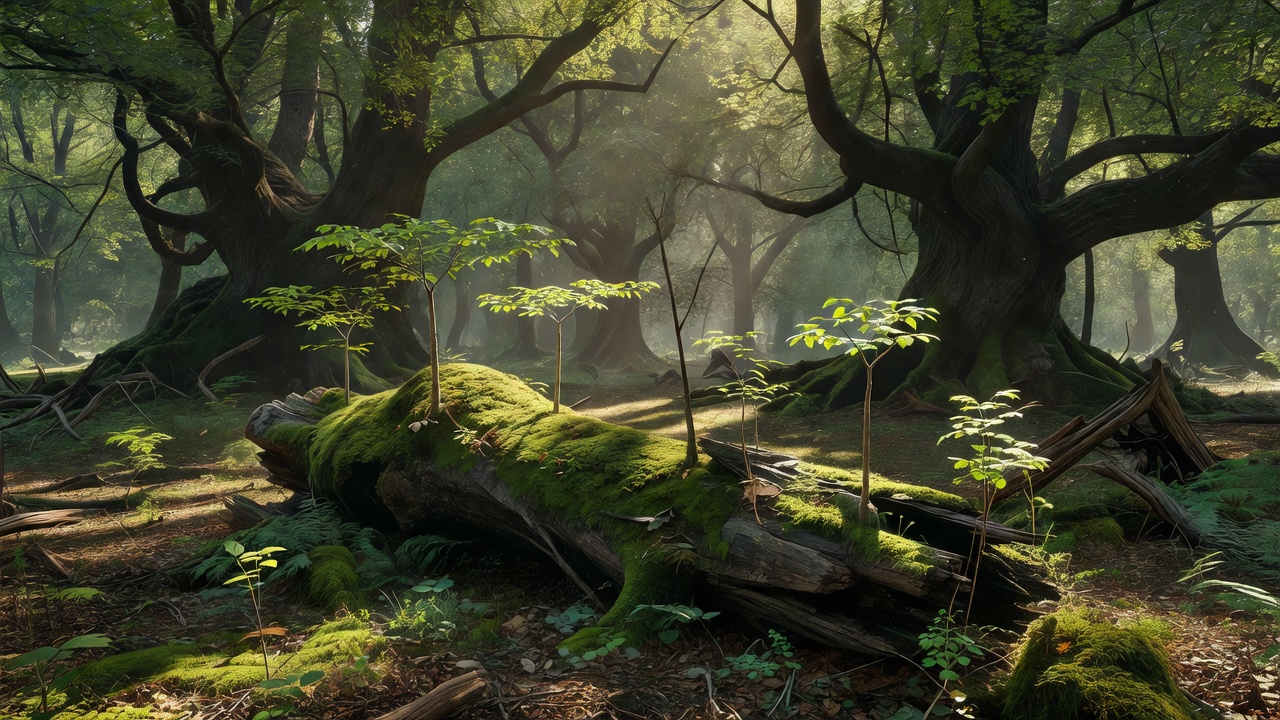
Begin with a fallen branch, a hollow trunk and a seedling. Their different ages are not contradictions: together, they help a woodland continue.
A forest is not a single organism with a birth certificate
On a woodland path, the most impressive tree often becomes the centre of attention. Yet an ancient forest is also the damp hollow beside it, the standing snag used by insects, and the young saplings waiting for light. Its importance comes from connected habitats and ecological processes, not simply from a collection of unusually old individuals.
“Ancient woodland,” “old growth” and “primary forest” are related but not interchangeable terms. Their definitions vary between countries, researchers and conservation systems. Ancient woodland commonly emphasises long continuity of woodland cover. Old growth often emphasises structural characteristics and late developmental stages. Primary forest definitions generally focus on native species, natural processes and the absence of clearly visible significant human disturbance. Read the definition attached to a claim before comparing places.
How age becomes evidence
Tree rings can provide powerful evidence of age, especially where annual growth produces recognisable boundaries. Dendrochronologists compare ring-width patterns across samples to place those rings in calendar time. Simply counting visible lines is less reliable: missing rings, false rings and damaged wood can complicate the picture.
A core that does not reach the original centre cannot, by itself, reveal the full age of a tree. Hollow trunks are particularly difficult. Researchers may combine partial ring sequences, growth models, historical records and radiocarbon evidence, depending on the question. A precise-looking number is not automatically a precise measurement. Good reporting tells you whether an age is directly dated, reconstructed or broadly estimated.
Great Basin bristlecone pine, Pinus longaeva, is a useful example. Some individuals in California’s White Mountains have lived for more than four millennia. Their weathered forms show that longevity does not require a complete cylinder of living bark. Surviving strips of tissue can maintain parts of a tree while exposed dead wood persists in a harsh environment. Exact locations of sensitive individuals should not become a treasure hunt.
Three places, three different histories
Białowieża Forest, spanning parts of Poland and Belarus, is valued for surviving examples of lowland forest processes and biodiversity. Its significance is not that every tree has escaped disturbance forever. It is that complex woodland structures and ecological relationships remain at a scale and quality that have become uncommon across much of Europe.
On Yakushima in Japan, humid conditions support forests containing Japanese cedar, Cryptomeria japonica, including celebrated old individuals. Visitors may encounter striking age estimates for named trees. Hollow interiors and incomplete records mean some of those estimates remain uncertain. The forest’s value does not depend on choosing the largest number printed on a sign.
In Utah, Pando is a clonal stand of quaking aspen, Populus tremuloides. Many stems belong to one genetic individual connected through a shared root system. A stem’s lifespan is different from the persistence of that clone. Estimates of a clone’s origin are much harder to establish than ring-dated ages of individual stems, so avoid presenting a speculative clonal age as a settled tree record.
Protect continuity, not just famous trunks
Ancient trees need more than a fence around their bark. Roots extend into surrounding soil; fungi, water movement and neighbouring vegetation shape their conditions. Soil compaction from repeated foot traffic can affect a tree without leaving an obvious scar. Stay on designated routes and resist stepping into a root zone for a photograph.
At landscape scale, protection includes retaining dead wood where safe, reducing damaging fragmentation, managing browsing pressure and supporting regeneration. The appropriate approach depends on local ecology and the rights and knowledge of people who live with the forest. A single management recipe cannot fit a wet island woodland, a dry mountain grove and a European lowland forest.
Planting new trees can be useful, but a plantation does not instantly replace centuries of habitat development. Ask conservation projects how they protect existing forest, monitor outcomes and care for the next generation. The most meaningful record is not an isolated age claim; it is the ability of a living system to keep renewing itself.
Continue the atlas
Giant trees: The architecture of great size