Field guide / 03 / Relationships
Ecosystems: Many worlds beneath one canopy
Notice where the water sits, how light reaches the ground and what happens to a fallen leaf. These small observations open the architecture of an ecosystem.
A forest begins with conditions, not a silhouette
From a distance, two forests may look like similar bands of green. Walk into them and the differences become immediate. One has wet leaves and dripping moss; another has open crowns, hard ground and a long dry season. Temperature, water availability, soil chemistry, disturbance and evolutionary history help determine which organisms can live there.
An ecosystem includes organisms and the physical environment with which they interact. It is not a perfectly balanced machine. Populations fluctuate, storms open gaps, rivers change course and species arrive or disappear. Understanding these changes makes woodland observation more interesting than searching for an imaginary forest untouched by time.
Cloud forests: life in suspended moisture
In tropical montane cloud forests, frequent contact with cloud can wet surfaces and influence water inputs. Branches may support mosses, ferns, orchids and other epiphytes. An epiphyte grows on another plant for support; that does not automatically make it a parasite. Many obtain water and nutrients from rainfall, trapped debris and the surrounding air.
Monteverde in Costa Rica is a well-known place to encounter this kind of forest. Its richness depends partly on fine differences in elevation, exposure and moisture. A warming climate can alter cloud conditions, while fragmentation can limit movement between suitable habitats. A cloud forest is therefore not protected merely because its most photogenic trees remain standing.
Mangroves: woodland at the moving edge
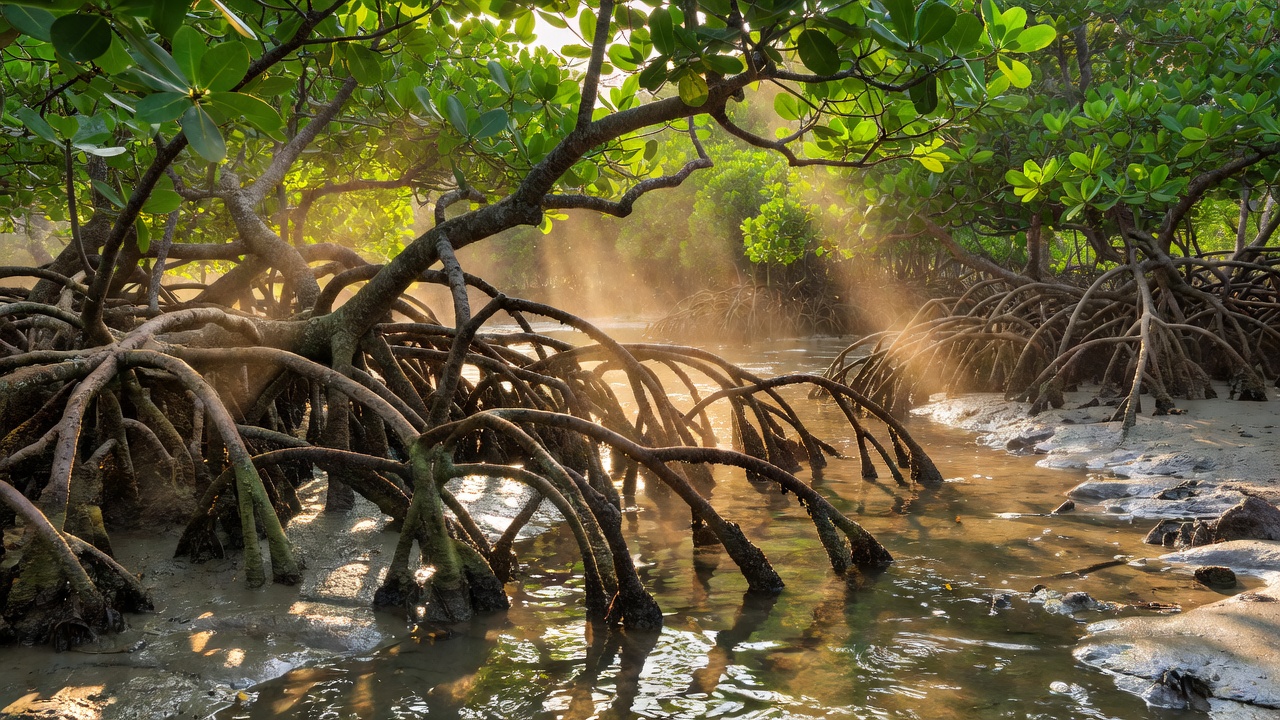
Mangrove forests occupy intertidal settings in tropical and subtropical regions. Their trees face saline conditions and waterlogged soils in which oxygen can be scarce. Different species possess different adaptations, including specialised root structures and mechanisms that limit salt entry or manage accumulated salt. There is no single mangrove design shared by every species.
The Sundarbans, shared by Bangladesh and India, illustrates the scale and complexity of a tidal forest landscape. Creeks, sediment movement and freshwater inputs influence its habitats. Mangroves can store substantial carbon and provide nursery habitat for many aquatic animals, but those benefits depend on local conditions. Planting seedlings on an unsuitable shoreline does not automatically restore a functioning mangrove ecosystem.
Temperate rainforests: a canopy with a wet floor
The Hoh Rain Forest in Olympic National Park offers a familiar example of a temperate rainforest. Conifers, broadleaved trees, mosses and ferns occupy a landscape with abundant precipitation. Fallen trees can become nurse logs, providing raised, moisture-retaining surfaces where seedlings establish. Decay is not a failure of the forest; it is one route through which materials return to circulation.
Dead wood supports organisms that living trunks may not. Fungi and invertebrates transform it over time, while cavities and loose bark create habitat. Removing every fallen branch to make woodland look tidy can simplify these relationships. Visitor safety may require intervention near infrastructure, but that is different from treating all dead wood as waste.
Dry woodlands: space is part of the structure
Not every healthy woodland forms a closed, humid canopy. Open dry woodlands may contain widely spaced trees, grasses and drought-adapted shrubs. Seasonal water stress, soils, herbivory and fire can all influence their structure. Judging them against a rainforest ideal risks mistaking natural openness for degradation.
Restoration should begin with the ecosystem that belongs in a place. Converting a naturally open habitat into dense tree cover can damage species adapted to light and space. Ask whether a project uses local ecological evidence, respects existing communities and monitors more than the number of planted stems.
Connections are real; simple stories can mislead
Mycorrhizal fungi associate with the roots of many plants. These relationships can involve exchanges of resources and can influence nutrient acquisition. Some fungal networks connect multiple plants, but the scale, direction and ecological importance of transfers vary. Evidence for a connection does not establish that mature trees intentionally nurture every seedling or that an entire forest acts as a single conscious network.
This simplified cycle is a starting point, not a complete map. Nutrients can be stored, lost or carried elsewhere; water and animals cross boundaries. On your next walk, choose one observation—a decaying log, an exposed root or a plant growing on a branch—and ask what conditions make it possible. Curiosity becomes more useful when it stays close to evidence.